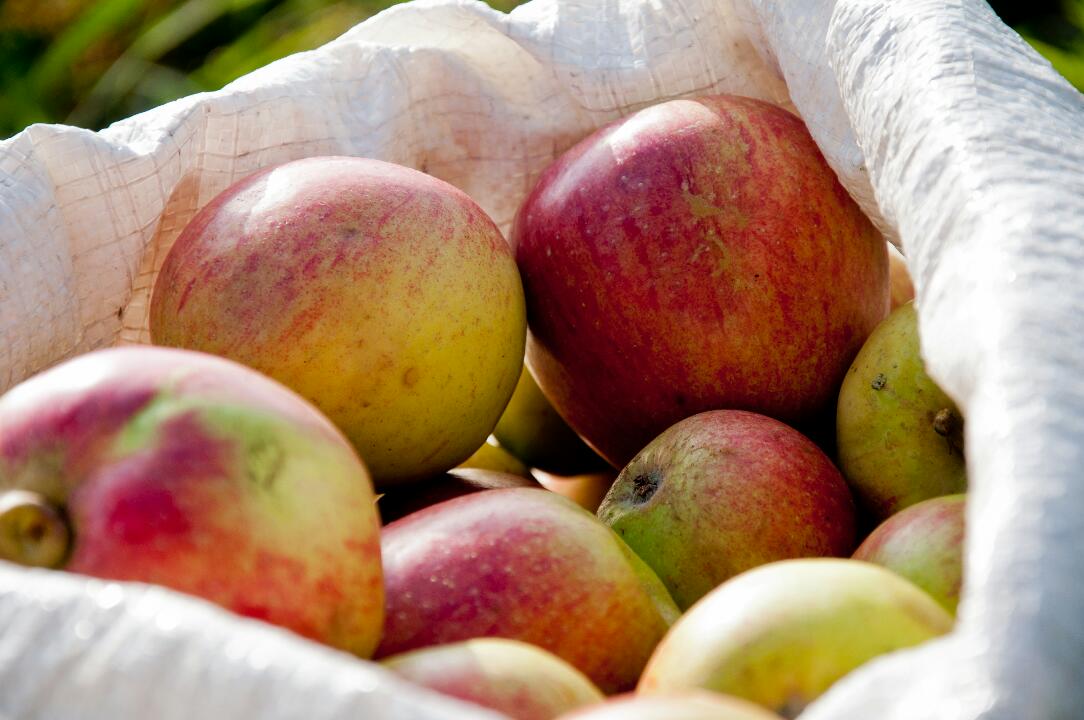
Each of these unique cultivars of apple tell a story about a time, a place and the people who lived and worked there, how they interacted with the land and the produce which came from it. Some of these stories go far back in time – Foxwhelp, Leathercoat – whilst others are from the recent past – Chapman’s Delight – but the vast majority first arose in the 19th century, or the first half of the 20th century, a time when orchards were a much more common sight than they are now.
Many of these varieties were almost lost; it’s striking to read how many were reduced to just 1 mature tree growing on a farm or found in just one orchard, kept alive only due to familial loyalty to an ancestor who planted or who first raised the cultivar – Ampney Red, Barnet’s Beauty, Dent’s Favourite, Gypsy Red, and many others. That they’ve been saved is down to the work of a small group of people, anxious and eager to conserve this vernacular history and the unique sequence of DNA that each variety represents, and within Gloucestershire the work of Charles Martell must be recognised. He visited all parts of the county in search of our ancient apple varieties, a journey that started in the 1980s and culminated with the publication of The Native Apple of Gloucestershire in 2014, from where much of the information below has been gleaned.
In creating a National Collection of Gloucestershire’s apple cultivars at our orchard at Longney we are now making sure the work of Charles Martell and others is secure, ensuring the continued survival of these apple varieties, many of which are still very rare.
Ampney Red
Dessert apple from Ampney Crucis, where it is recorded as being common, before 1939.
There is one remaining mature tree at Birch House, Ampney Crucis, believed to have been planted by Mr Bridgeman, who planted several apple trees at Birch House (formerly Birch Farm). Mr. Bridgeman was a noted local eccentric, who milked cows and had his own delivery round during the 1939-1945 war, when he used to tell his customers he had put arsenic in the milk. Ampney Red is considered to be a good eating apple with good keeping qualities.
Ansell
Cider apple, probably from Oldbury-upon-Severn. First known reference was in 1886 (Hogg).
Still grown in Oldbury, also known from Arlingham, Berkeley, Huntley, Tibberton and Dymock. There are reports that there were two varieties, Yellow Ansell (the one displayed here) and a White Ansell, which had less colour and came from Arlingham.
The tree is a burr knot i.e. it bears adventitious roots on its branches, which can be removed and planted in the soil to allow propagation without grafting or budding.
Arlingham Schoolboys
General purpose (but very edible) apple from Arlingham, first recoreded in c. 1914
The last known mature tree in Arlingham died in 1993, but the variety is known in Awre and Minsterworth. The tree grows vigorously and can be distinguished by apple-sized lumps on its trunk and limbs, similar to Blenheim Orange. Possibly susceptible to canker.
Ashmead’s Kernel
Dessert apple from Gloucester, dating back to c. 1790.
Gloucestershire’s most famous dessert apple, of outstanding quality. It was first raised in what is now Clarence St., although there is some question about the identity of the Dr. Ashmead responsible; it may have been Dr. William Ashmead, “an eminent physician”, who died in 1727, aged 47, or William Ashmead (1721 – 1782), an attorney (at this time, a lawyer would have also been titled ‘Doctor’).
Although it gained acceptance in Gloucestershire from its early days, it was only in the 1960s it came to national prominence, eventually gaining its First Class Certificate from the Royal Horticultural Association in 1981 – after almost 300 years!
Ballast Apple
Cider apple from Shepperdine, from about 1945.
Also known as Ben Lans in some parts of Gloucestershire (Minsterworth) but DNA analysis has revealed they are one and the same apple. Known to have been grown in Walmore Hill and Halmore, also from Ashworthy Farm, Stidcot, Tytherington until the 1960s, so clearly an apple that was appreciated at one time.
Barnet’s Beauty
Dessert apple, first raised at Bell Inn Farm, Berkeley, distributed from 1945.
Raised by Charlie Barber (1868-1950). The Bell Inn is mentioned in Dickens’ Pickwick Papers. Dickens stayed at the inn on his way to Tewkesbury, as did the characters in the book. Charlie Parker moved to the farm in 1917 and changed the name to The Chestnuts. His great nephew Michael Jordan took over the farm in 1950 and changed the name to Pickwick Farm (he still owns the original Bell Inn sign).
There is one old tree left at Woodford Green, Berkeley, where a cider business was based until 1957.
Bedminster Pippin
Dessert apple, said to have originated in Gloucestershire, according to Smith, M.W.G., National Apple Register of the United Kingdom (1971).
Little is known about the provenance of this apple, other than it was received into the National Fruit Collection in 1952, which suggests at that time it was considered to possess enough quality to qualify for admission.
It’s a tip bearer, with fruit ripe in mid-season.
Bedminster is a district of Bristol, part of what would have been Somerset until incorporated into Bristol in 1373, under Edward III’s proclamation.
Ben Lans
See Ballast Apple
A synonym of another Gloucestershire apple, but DNA analysis has revealed they are one and the same.
Box Kernel
General purpose apple, from Box Farm, or Little Box Farm, in Awre. Mature trees are recorded in the 1960s, so much older than that.
It has been reported a 3 ½ acre orchard at Guy Hall, Awre, was planted only with this variety, so of some repute – but the orchard was grubbed up in the 1970s. Cider made from this apple is said to be ‘ropey’ (which may not be the fault of the apple!). Its main use is as a culinary apple; it makes excellent crumble without the need for extra sugar. The fruit will hang on the trees ‘until apples come again’.
Brown French
Cider apple from Hill Farm, May Hill, from before 1931.
Use of the word ‘French’ to describe a cider apple suggests it comes from Gloucestershire, in the same way ‘Norman’ apples come from Herefordshire and ‘Jersey’ apples come from Somerset. DNA analysis has revealed that the Gloucestershire apples Bill Norman and Bushy French are the same as Brown French. The fruit is reported to shake well, with the whole crop falling together, and is said to be dry and very bitter, so presumably a bittersweet or bittersharp cider apple.
Cambridge Quoining
Cider apple, names after the hamlet south of Gloucestershire rather than the Fenland capital, home of the fine and famous university. From between 1903 – 1929.
The name ‘quoining’ may be derived from the French word ‘coin’, meaning corner, a reference to the apple’s angular, ribbed appearance. The apple is sometimes referred to as Cambridge Queening. The fruit is susceptible to twinning, a result of it’s very short stalk; two apples on the same fruiting spur have no option but to graft together in order to develop. Fruit was submitted to Long Ashton cider competitions between 1903-1929 and was classified by LARS as a sharp cider apple (high acidity, low tannin).
Chaxhill Red
Cider apple from Chaxhill House, raised before 1873. Also a general purpose apple.
Raised by Squire Bennett of Chaxhill House, the apple won a First Class Certificate for cider at Gloucester in 1873. Squire Bennett was a friend of William Viner Ellis, a renowned pomologist of the late 19th century.
Chaxhill was a leading centre for fruit growing in Gloucestershire; a) it’s proximity to Gloucester, within reach by horse and cart; b) proximity to Grange Court train station (also the site of a fruit market); and c) adjacent to the R. Severn, where trows (sailing barges) could transport fruit to South Wales (where Chaxhill Red was referred to as Welsh Cox).
Chapman’s Delight
Eating apple from Harpury,
Gloucestershire’s newest apple? it was discovered by Jim Chapman, the Trust’s former Treasurer and former Chair of Trustees, found in a hedge he had planted (using a Countryside hedge-planting pack!) to form a windbreak for a perry pear orchard. On discovering a sweet, tasty apple, he guarded the tree to protect it from livestock and carefully nurtured it. In 2019, fruit from the tree was juiced, entered into the Malvern Show … where it won 1st prize! The name Chapman’s Delight was registered with the Register of Local Cultivars in 2020, and its parentage is thought to be Gloster 69 x Golden Delicious (Gloster 69 being nothing to do with the City of Gloucester or Gloucestershire, it being ana apple from Netherlands, where it is widely grown).
Corse Hill
General purpose apple from Corse Hill Farm, from before 1884.
Raised by Mr Merchant of Corse Hill Farm. Mr Merchant’s son, Walter (1900-1974), recounted how, as a boy, he rode on the horse drawn cart with a whip to discourage children from stealing fruit being delivered to the John Stephens & Son’s pickle factory on Skinner St., Gloucester.
Several trees of this variety have been planted at Corse School.
Dent’s Favourite
General purpose apple from Broadway, Minsterworth, date unknown.
Little is known about this apple, other than the fact that the only known mature trees are found in Broadway, Minsterworth. Adjacent to Chaxhill, this area to the west of the River Severn is the most prolific source of Gloucestershire’s apple cultivars.
Dymock Red
Cider apple from Dymock, dating back to 1600s (possibly Gloucestershire’s oldest apple).
First mentioned in John Evelyn’s Pomona (1670), this probably arose as a 2nd generation cider apple, derived from Lord Scudamore’s importation of bittersweet apples from Europe. Regarded by LARS as a first class, vintage cider apple, on a par with the celebrated Kingston Black, containing sufficient flavour and acidity to be used for single variety production. The parish of Dymock by be unique in having an apple, a pear and a plum named after it, all called Dymock Red (although the pear’s proper name is Thurston Red, a well-known perry pear).
Eden
Dessert apple from Falfield, 1948.
The parentage of this apple is John Standish x Cox’s Orange Pippin, first raised by E.J. Ingleby of Forest & Orchard Nurseries, Falfield in 1948, distributed by Matthew Fruit Trees of Bury St. Edmunds, Suffolk, from 1957.
It is a sister seedling to Fon’s Spring and the two were considered synonyms of each other until 2002, when DNA testing revealed them to be different cultivars.
This is a delicious apple, well worth including in any orchard.
Elmore
Dessert apple from Elmore, south of Gloucester, alongside the River Severn, from before 1949.
Although this cultivar is included within the National Fruit Collection, there is no information about its provenance, although its name suggests Elmore, the parish south of Gloucester, where it still grows.
The apple ripens very late, with fruit still on the tree in mid-November.
Fawkes’ Kernel
Cider apple from Little Nehterton, Dymock, first recoreded in 1886.
First mentioned by R. Hogg (1886), who thought the cultivar was first raised in the late 1700s, by the Fawke family of Netherton, Dymock, where another apple, Netherton Nonsuch (sadly now extinct, or missing) was also raised. Hogg spelled it Fawkes’ Kernel, rather than Fawke’s Kernel. The 1851 census records Joseph Fawke, aged 48, farming in Dymock, with many other Fawkes in the parish.
The juice characteristics suggest it is a sharp cider apple, with little astringency, similar to Tom Putt.
Flower of the West
Dessert apple from Westbury-on-Severn, or Minsterworth, from before 1920s.
Little is known about this apple, which is known to have been grown in Minsterworth, also in Westbury-on-Severn. It’s attractive, russeted appearance disguises a pleasant taste but with little character or complexity, although a large number of trees of this variety were planted at Big Naite Farm, Misterworth, in the 1920s, suggesting it was appreciated at that time.
Fon’s Spring
Dessert apple from Falfield, 1948
A sibling of another Gloucestershire apple, Eden, the parentage of this apple is also John Standish x Cox’s Orange Pippin, first raised by E.J. Ingleby of Forest & Orchard Nurseries, Falfield in 1948, distributed by Matthew Fruit Trees of Bury St. Edmunds, Suffolk, from 1957. Very rare, as it was considered to be a synonym of Eden, the more popular name for the variety, and it was only discovered to be a separate cultivar in 2002, courtesy of DNA testing.
This is a delicious apple, well worth including in any orchard, only more so, due to its rarity.
Gilliflower of Gloucester
Dessert apple from Saul or Arlingham, first recorded in 1945.
A tree of this variety, from Saul, was received and accepted by the National Fruit Collection in 1952 and recent DNA analysis has confirmed it’s a unique cultivar, but information of its provenance is otherwise limited.
R. Hogg (1884) says ‘gilliflower’ (writing about Cornish Gilliflower) is derived from the French ‘girofle’, a clove, because the blossom is alleged to smell of that spice.
Foxwhelp
Cider apple from the Forest of Dean, first recorded in 1653.
Possibly Gloucestershire’s oldest apple (see also Leathercoat), first mentioned by Ralph Austin in 1653, although the tree which provided the fruit depicted in the Herefordshire Pomona is believed to have been planted in 1609. The apple itself is a famously sharp bittersharp cider apple, now widely planted in Herefordshire and made famous by Herefordshire’s cider-makers. The skin is yellow, beautifully striped with bright crimson and is easily identifiable by its appearance.
Foxwhelp is prone to producing sports (mutations), a result of which there are a proliferation of varieties bearing the Foxwhelp name; Red Foxwhelp, Broxwood Foxwhelp, Rejuvenated Foxwhelp, Improved Foxwhelp, Sonoma Foxwhelp (and others), but some of these have no relationship to Foxwhelp – the original Foxwhelp – at all.
How it came to be called Foxwhelp is something of a mystery. R. Hogg suggested it was because a seedling was found near a fox’s den, or that a foxhunter discovered it, attracted by its colourful fruit. There is even a suggestion that the eye of the fruit resembles the physiognomy of a fox cub. Ultimately, it came to be called Foxwhelp thanks to the native wit and wisdom of Gloucestershire’s citizenry, over 400 years ago.
Gloucester Royal
Dessert apple from Dursely, first raised c. 1930, first fruit in 1941.
One parent of this variety was thought to be McIntosh, an apple that is now popular in the USA and whose name inspired the Apple Mac computer … but recent research has revealed that’s not the case; both parents are now unknown. The variety was raised in Dursley by J.W. Thornhill, then distributed from 1956 by Matthews Fruit Trees of Bury St. Edmunds, Suffolk (as with Eden and Fon’s Spring).
Gloucestershire Underleaf
General purpose apple of uncertain provenance, but know to have been grown in Oxenhall, first recorded in 1883.
A well known and much liked apple in its home county, appreciated for its versatility – eating, cooking and cider-making – but for all its popularity, its exact provenance is unknown.
Possibly called ‘underleaf’ either because the leaves grow under the fruit or because the fruit grows under the leaves … and inspection of trees in full fruit is inconclusive!
Gypsy Red
Cider apple, whose exact provenance and history in unknown.
The only known mature tree has been found at Churngate Farm, Kington, near Oldbury-on-Severn, from where scions were taken in 2003 for propagation. The apple itself has a distinctive appearance, red flushed with faint darker red pinstripes. DNA analysis has confirmed it is a unique cultivar.
Hagloe Crab
Cider apple, assumedly named after the hamlet of Hagloe, near Berkeley, but best known for being grown in Bulmers’ orchards, in Herefordshire. Dates back to c. 1720.
A variety about which there has been much confusion, as two different apples competed for the same name. For a short period, this variety was referred to as Hagloe Crab (Bulmers) and the competitor as Hagloe Crab (Phelps), but the application of DNA testing and diligent work by pomologists has resolved the issue, confirming the Bulmers version to be true, with the Phelps version now called Tupstones.
Hagloe Crab was illustrated in T.A. Knight’s Pomona Herefordensis (1811), as well as R. Hogg’s The Fruit Manual (1884) and which grows in Bulmers’ cider orchard in Herefordshire. DNA analysis has revealed there to be 2 different cultivars, but given that both bear the name ‘Hagloe’ it can be assumed both the Bulmers and the Phelps varieties had a close association with Gloucestershire.
Tupstones
Cider apple, once confused with Hagloe Crab, dating back to at least 1796.
A variety once highly esteemed. W. Marshall, in The Rural Economy of Gloucestershire (1796) wrote that cider of this apple would be exchanged “barrel for barrel for spiritous liquor,” and thought the trees were, at that time, about 70 years old. This is the variety that Ray Williams of LARS worked with in the 1950s and obtained grafts from a tree at H.J.Phelps’ old orchard at Tibberton, from where more recent scions have been taken for Gloucestershire’s collections and incorrectly named Hagloe Crab.
Of course, we cannot be exactly sure whether W. Marshall was writing about the apple then called Hagloe Crab, now called Tupstones, or then called Hagloe Crab and still referred to as such.
Hard Knock
Cider cum culinary apple from Oxenton, thought to have been raised in 1940s.
Only known to have grown in Oxenton, but of unknown age; the trees from which scions were taken in 2000 for National Collections were both old, so an assumption the cultivar was first raised around the 1940s (or before) seems reasonable. The fruit has a reputation for ripening at the same time, so its name may refer to the feeling of these heavy, dense apples dropping on cider-makers when harvesting with a panking pole.
Hens’ Turds
Cider apple, found to be growing in Rodley, but of unknown age, assumed to be early 20th century.
The origin of its unusual, disparaging name is not known, but the name has attracted attention, as a result of which it has been included in newly planted orchards, its future now rather more secure than at the start of the milenium, when the only known tree was growing at Rodley Court, Rodley, near Westbury-on-Severn.
Holbroke
Cider apple from Halmore, Berkeley, thought to have been raised mid-20th century.
Little is known about this apple, other than it was considered to be a “scrumper” or cask-filler, rather than grown and used to make cider on its own merits.
Hunt’s Duke of Gloucester
Dessert apple from Gloucester, first raised in 1820s.
Raised by Dr. Fry of Gloucester, then introduced by T. Hunt of Straford-upon-Avon in 1820.
There may be a connection with Fry’s chocolate manufacturer of Bristol, makers of the world’s first chocolate bar, Fry’s Chocolate Cream (launched in 1847) and Britain’s first Easter egg (1873). Joseph Fry founded the business in 1728, his wife Anna ran the business after he died, together with their son, another Joseph. When she died, Joseph went into partnership with a Dr. Hunt … and it may be these two who are responsible for this apple.
At one time this apple was confused with Puckrupp Pippin, another Gloucestershire cultivar, although they are not alike – a result of samples being mixed-up in a laboratory.
Puckrupp Pippin
Dessert apple, assumed to be from Puckrup, near Tewkesbury, first recorded in 1872.
Its provenance is assumed to be Puckrup (one ‘p’), a settlement to the north of Tewkesbury. Puckrupp Hall, now a hotel, was the centre of a substantial estate, and Victorian gentry were interested in fruit and breeding new cultivars, so there is a possibility this in its provenance, although there is no evidence for it.
For a time, this apple – a delicious and sweet, small, yellow, russeted apple – was mistaken to be Hunt’s Duke of Gloucester, and vice versa.
Jenny Lind
Dessert apple from Strand, Westbury-on-Severn, assumed to be late 19th century.
Jenny Lind (1820 – 1887), also known as the Swedish Nightingale, was a famous opera singer, more recently popularised in the 2017 film, The Greatest Showman. Such was her fame that theatres, schools, an hospital ward, streets and roads, several pubs, a dam, a locomotive as well as a steam ship – and many other buildings – were named after her … and also an apple. It’s assumed this naming frenzy happened from the peak of her fame (1850s) until after her death from cancer (1887). She is buried in Great Malvern cemetery. Little is known about the provenance of the apple, other than the fact it was found growing in Strand.
Jill Jefferies
Dessert from Siddington, Cirencester, 1934.
Believed to have been raised by Edward Jeffreries, grandfather to Jill and Tim, father to John, who established the Siddington nursery John Jefferies & Son. The variety was raised before Jill was born and only named after the trees bore fruit … and the fruit deemed of good enough quality to be named after Edward’s grand-daughter.
The original tree was still standing in 2000, from which scions were taken for propagation for National Collections.
Josey
Cider apple from the Forest of Dean (Brockweir, Whitefliffe or Ruardean), from 1930s.
A Forest of Dean cider variety, once grown in respectable quantities in an orchard owned by the Berrow family at Whitecliffe. James Berrow had a horse-drawn cider-mill and press and would travel the district to make cider on behalf of local citizens … so a cider-maker’s apple. It’s considered to be a Bittersweet cider apple.
Kempley Red
Cider apple from Kempley, near Dymock, from before 1931.
First recorded as Kempley Red in Hereford Apple Shows in the early 1880s, but after that the variety became known as Carrion Apple, a result of it appearing in R. Hogg & H. Bull, The Apple and Pear as Vintage Fruit (1886) under that name, because the tree from which Hogg & Bull obtained their samples, in Pyon, Herefordshire, was used to hang carrion and was so-called by the owner of that particular tree.
In 2024, the Register of Local Cultivars adjudicated that Kempley Red is the correct name for this apple.
Kenchy Pippin
Cider apple from Halmore, Berkeley, of unknown age but “from a long time ago”, quoted in 1995, so possibly early- to mid-20th century?
This variety was planted by the Summers family, to provide cider fruit for the cider house at Halmore, The Apple Tree, which they owned at one time. It was one of the last cider houses in Britain.
The variety has a thin skin and if left in grass it splits. As a cider apple, it has a hint of astringency, is described as juicy but not crisp, so should probably be classified as a Sweet cider apple (rather than a Sharp, Bittersweet or Bittersharp).
Kernal Underleaf
Cider apple from Longney, of unknown age.
Waterend Farm, Longney, is the only orchard where old trees are known to grow, other than those planted from propagation in National Collections and by nurseries. The orchard was owned by David Browning, who once also owned the Gloucestershire Orchard Trust’s own orchards at Longney, and he suggests the trees may have been planted as pollinators, as they are scattered around the orchard rather than grouped together, rather than for the quality of the fruit, which is described as being “dry, firm and insipid”!
Kill-boys
Cider apple from Shepperdine or Oldbury-upon-Severn, from before 1886.
First mentioned by R. Hogg and H. Bull, in The Apple and Pear as Vintage Fruits (1886), when it was described as an established variety. Its intriguing name is ascribed to its “acrid rough taste”, according to R. Hogg, although local legend has it that a man and a boy were gathering fruit together; when the boy started playing the fool, the man threw and apple at the boy, hit him on the head, and the hardness and density of the apple killed the boy.
The fruit has very little astringency and the trees grow with a drooping habit.
King Apple (Martell)
Cider cum dessert apple from Bollow, Westbury-upon-Severn, thought to date from c. 1900s.
A very mild bittersweet cider apple, which is also edible when ripe.
This is different to other King Apples; both Warner’s King and Northern Spy are known as King Apple, but whose descriptions and DNA differ from King Apple (Martell), as does King of the Pippins.
Lake’s Kernel
Dessert apple from Ashelworth, first exhibited in 1905.
Thought to be raised by Bill Lake, a blacksmith of Hartpury, who brought the variety to Ashleworth. Bill Lake had his blacksmith’s workshop opposite the Royal Exchange public house in Hartpury. Jack Lake (presumably related) was also a blacksmith but lived in nearby Hasfield; his workshop was adjacent to Hasfield Court. Decendents of Bill Lake still live in the neighbourhood of Ashleworth.
The apple has pale, fine flesh and is firm, with an appealing sub-acid flavour.
Leathercoat
Dessert apple from the Vale of Berkeley, dating back to the 1500s – making it Gloucestershire’s oldest apple
“There is a dish of Leathercoats for you,”
… says Davy to Bardolph, in Shakespeare’s Henry IV part 2, so setting the scene in Gloucestershire.
The variety was also described by R. Hogg in The Fruit Manual (1884), so was still in cultivation then. This is a roughly russeted apple, the flesh is green, crisp, juicy, both sweet and briskly flavoured, perhaps not to everyone’s liking but certainly a taste of history.
Lemon Roy
Culinary apple from Broadway, Minsterworth, of unknown age but first raised before 1813.
Although little is known about the provenance of this cultivar, or how it got its name, recent analysis done by academics in England, France and Netherlands has revealed this apple to be one of the very early apples and parent to:
Edward VII, Green Harvey, Hormead Pearmain, Jubilee, Lombarts Calville, Longney Russet, Stanway Seedling and Wickham Green.
Given that Green Harvey dates back to 1813 and Hormead Pearmain to 1826, Lemon Roy must be an ancient variety.
Lodgemore Nonpareil
Dessert apple from Lodgemore, Stroud, dating back to 1808.
Raised by Mr. Cook of Lodgemore, near Stroud, and then further propagated and distributed by a nurseryman, Mr. Clissold, who sold it under the names Lodgemore Seedling, then Clissold’s Seedling. R. Hogg’s The Fruit Manual (1884) refers to it by its current name.
The flesh is firm, juicy and pleasantly sweet.
Longney Russet
Cider and general purpose apple, from Longney, first recorded in 1796.
First mentioned in W. Marshall’s The Rural Economy of Gloucestershire (1796), but omitted from Robert Hogg’s works, this variety can still be found to be growing around Longney, also across the River Severn, in the Minsterworth / Bollow area.
It has excellent keeping qualities (if kept properly) and becomes more edible the longer it’s kept. It also attracts a range of opinions; some cider-makers think it’s an excellent apple for cider-making, others think it more suited to chucking in the river.
Longstalk
Cider apple from Longney, Elmore or Bollow, dating back to the first part of 20th century.
Although still well known in the Minsterworth and Longney parishes, across the River Severn from each other, little is known of the provenance of the variety.
The reason for its name is self-evident, which makes the fruit difficult to harvest shaking – the fruit just flops around on their long stalks.
As a cider apple, the fruit has little or no astringency, so a sweet or sharp cider apple.
Martin’s Kernel
Dessert apple, probably from Arlingham, from before 1953.
Although accepted into the National Fruit Collection at Brogdale in 1953, little is known about its provenance or the Martin (first or last name?) after whom it was named, although it has been recorded as coming from Arlingham from several sources.
The flesh is described as being crisp and juicy, but with little flavour.
Molly Kernel
Dessert apple, probably from Oldbury-on-Severn, mid 20th century,
Little is known about this apple, other than it is a variety planted in several orchards in and around Oldbury. The variety is also known to exist in nearby Halmore.
Northland Seedling
Dessert apple from Tetbury, first recorded in 1930.
Raised at Northland Cottage, Tetbury, by A.P. Kitcat, and was received at Brogdale for inclusion within the National Fruit Collection in 1930. The flesh is firm and crisp, with a sub-acid flavour.
Old Tankard
Cider apple from Northwood Green, near Westbury-on-Severn, estimated early- to mid- 20th century.
Little is known about this cider apple. The only known mature tree, from which scions were taken for propagation, was at Merestones, Northwood Green, near Westbury-on-Severn, was already old and recumbent in 1994.
The fruit bruises easily, the flesh is white, juicy, with a fresh, acid flavour and although regarded as a cider apple, it makes for tolerable eating at Christmas.
Over Apple
Cider apple from Over, Gloucester, thought to be mid- 20th century.
Assumed to have come from Over, the hamlet north of Gloucester which has served as a crossing point of the Severn for centuries (the single arch 150 foot stone bridge was designed by Telford and completed in 1828, which replaced an 8-arched wooden bridge which had stood since the early 13th century). This Over is closest to the location of the only known mature tree, but there is also an Over near Almonsdbury, also an Over Court near Bisley, once home to Queen Elizabeth I.
Another Gloucestershire variety, Royal Turk, is a synonym of Over Apple.
Overleaf
Cider apple from Broadway, Minsterworth, estimated to be mid- 20th century.
A veriety once widely grown west of the River Severn, this apple’s name is in contrast to Gloucestershire Underleaf, but shares with that apple a mystery whether it is so named for a habit of fruit growing over the leaves, or the leaves growing over the fruit, as observation reveals both to be present.
The mature tree found growing in Minsterworth had an extreme weeping habit and was described as looking like an octopus on a stick. Such trees need careful pruning, as the weeping branches act as support, to keep the tree upright and aloft.
Overton Red
Cider apple from Tirley, estimated mid- 20th century.
An apple studied by Long Ashton Research Station, and described as a medium sharp cider apple, also useful for juicing.
There are several places called Overton, the nearest to the location where the tree was found is near Maisemore, north of Over and Gloucester. The variety has also been reported to be found in Hasfield, near Ashleworth.
Pear Box
Cider apple from Kington, near Oldbury-on-Severn, thought to be mid- 20th century.
Another apple about which little is known, including the provenance of its name. “Pear” may be a homophone of “père”, but whose father is beign referred? Another suggestion is that fruit from the tree was stored in a box bearing the name of Pears Soap and the name stuck.
The only known mature tree is small, has the reputation for being a good cropper and was found growing in Churngate Farm, Kington … as was Pedington Brandy.
Pedington Brandy
Cider apple from Kington, near Oldbury-on-Severn, thought to be mid- 20th century.
Another variety about which little is known, other than it, too, was found growing at Churngate Farm, Kington, like its orchard-mate Pear Box.
Both Appleridge Pippin and Middle Hill Brandy (both now missing, presumed extinct) were apple cultivars sent to Long Ashton Reasearch Station by A.T. Price, of Berkeley. Appleridge Farm neighbours Pedington Farm, so Pedington Brandy may well have originated from the same farm.
It has been suggested that mixing this variety with Kingston Black will make an excellent cider.
Red Styre
Cider apple from the Forest of Dean, first recorded in 1884.
The word “styre” refers in general to cider apples from the Forest of Dean, and this particular variety is a bittersharp cider apple. It was first mentioned by R. Hogg in The Fruit Manual (1884). The variety was on the planting list of cider-makers H.P. Bulmer & Co, who hold records dating back to 1927, from which it was discovered the variety was planted at ‘Llwynon’ on 23rd and 27th March, 1932. Sleuths at the Marcher Apple Network revealed that ‘Llwynon’ had been anglicised to ‘Ashgrove’, located the property, confirmed the trees were still growing there and have provided scions for propagation.
Reynold’s Crab
Cider apple from Minsterworth, first recorded in 1884 (if the same apple).
R. Hogg and H. Bull in The Apple and Pear as Vintage Fruit (1886) mention Reynold’s Kernel / Raynal’s Crab, which may be the same apple as Reynold’s Crab, listed as an entry in Long Ashton’s List of Entrants, Cider Variety Competition (1903-1929). According to Hogg and Bull, the fruit makes “the very best cider”, but other, more recent reports, suggest otherwise.
It’s a bittersharp variety.
Rhead’s Reinette
Dessert apple from Elton, or Flaxley, dating back to c. 1900.
Raised by William Rhead (1852-1955) at either Elton Farm, Elton, or Peglar’s Farm, Flaxley, the exact date unknown but 1900 is around the mid-point of his life. The continuity of the variety was ensured by his grand-daughter, Peggy Wellington, at Cyprus Cottage, Minsterworth, the tree having been grafted by her husband, Bob Wellington, a well-known fruit expert.
The flavour of the apple is comparable to Cox’s Orange Pippin.
Rock Kernel
General purpose apple.
An apple about which little is known, regarding both age and provenance. In Dymock there is an Old Rock Farm and a New Rock Farm, which may be where the variety arose.
The flesh is described as being “tough”.
Severn Bank
General purpose and cider apple from the Severn Vale, first recorded in 1884.
Once a widespread, commercial variety, shipped to markets in the Midlands by trow (sailing barge) and train, it can still be found growing in the Severn Vale. It’s considered to be a good, early cooker (ripening at the same time as blackberries), it also had a reputation for use as a cider apple, the cider being ready by Christmas.
As with many popular varieties, it comes in more than one form and there may not be a “true type” of this old, working variety.
Shopground Kernel
Dessert and culinary apple, from Broadway, Minsterworth, thought to be mid- 20th century.
Very little is known about this apple, its age or provenance. The only known mature trees are found at 2 sites, both near Broadway, Minsterworth.
The flesh has a good balance of sugar and acidity, but it may have a tendency to suffer from a condition called “water-core” in which areas of the flesh have a transparent appearance and a pineapple flavour.
Siddington Russet
Dessert apple from Cirencester, first raised in 1923.
Discovered at the nursery of John Jefferies & Sons, as a sport of Galloway Pippin, then listed and sold as Siddington Russet in that nursery’s catalogue as a separate variety, from 1930.
The nursery was first established in 1795 and was responsible for the introduction of another Gloucestershire variety, Jill Jefferies.
Stantway Kernel
General purpose apple from Stantway, Westbury-on-Severn, of unknown age but probably early- to mid- 20th century.
An apple about which little is known, regarding both age and provenance, but assumed to have originated in the village of Stantway, near Westbury-on-Severn. The only known mature trees are growing at Broadway, Minstersworth.
Sugar Pippin (Martell)
Dessert apple from Walmore Hill, Minsterworth, of unknown age but probably early- to mid- 20th century.
Another apple about which little is known of its age or provenance. A Sugar Pippin was sent to Long Ashton’s cider variety competitions between 1903-1929, which came from Dymock. A Sugar Apple is mentioned in the Herefordshire Pomona (1886), but its description is quite different.
The flesh is described as pleasantly sweet, when ripe.
Taynton Codlin
Culinary apple from Tibberton, dating back to 1954.
Raised as a seedling at Grifffins Farm, Tibberton, near Taynton, reputedly growing out of a cow pat, hence an early name for it was the Cow Apple.
It’s used in the preparation of mincemeat for Christmas, as it doesn’t lose its moisture during storage.
The village of Taynton is well aware of its fruit growing heritage, with this apple bearing its name, also two perry pears, Early Taynton Squash and Late Taynton Squash, also the Excelsior of Taynton walnut.
Tewkesbury Baron
Dessert apple from Tewkesbury, first recorded in 1883.
The origin in unknown, but assumed to be Tewkesbury, Gloucestershire, rather than Tewkesbury , New Jersey, USA, particularly as old trees have been found growing in Westbury-on-Severn, Corse Lawn and Oxenton, these last 2 being within the Tewkesbury administrative district.
The fruit ripens to a deep crimson, particularly on the side facing the sun, and the flesh is described as sweet and richly flavoured, but with some sharpness.
Transparent Codlin (Martell)
Culinary apple from Walmer Hill, Minstersorth, dating back to late 1950s.
Known to have grown in Minsterworth, this is a different Transparent Codlin to those listed in R. Hogg’s The Fruit Manual (1884) or in M. Smith’s The National Apple Register (1971), on account of both its colour and cropping season. The Gloucestershire version ripens towards the end of July, making it one of the earliest apples of the season.
John Jefferies & Sons listed a Transparent Codlin in their catalogues in the 1930s, but with no description, so it may have been any version of the fruit.
Upright Styre
Cider apple from the Forest of Dean, dating back to 1920s or 1930s.
Trees of this variety have a vigorous and vertical growing habit, hence its name. It was listed within the planting records of H.P. Bulmer & Co. and an orchard planted by the company in 1932, in Glasbury-on-Wye, in Powys, has been the source of wood for propagation.
The word “styre” refers in general to a cider apple from the Forest of Dean.
Welsh Druid
General purpose apple from the Forest of Dean, thought to date back to early 1900s.
This variety is a burr-knot i.e. it has vestigial roots on its branches, which can be planted directly in the soil, without the need for grafting. The variety arose in The Kennels, Lower Meend, Bigsweir, and was kept alive by Miss Christine Chilver and Mrs. Alex Felgate, the former being a secret agent code-named “Fifi”, a member of the SOE during WW2. She was born in London, raised in Latvia, fled to Sweden, studied at the Sorbonne, escaped back to London in 1942 and joined the SOE, as she spoke a number of European languages fluently. At one time, she was the custodian of the only Welsh Druid tree in existence.
Wheeler’s Russet of Gloucestershire
Dessert apple from Bollow, Westbury-on-Severn, of uncertain age.
A different apple to the Wheelers Russet mentioned by R. Hogg in The Fruit Manual (1884), and one with an uncertain history and once very rare, with just 2 known trees growing on the right bank of the Severn.
It’s reported that if kept, the fruit develops a banana flavour, a characteristic it shares with Ribston Pippin.
Wick White Styre
Cider apple from the Forest of Dean, of unknown age, but first named in 1993.
The word “styre” refers in general to a cider apple from the Forest of Dean.
This variety was named by Ray William, cider pomologist at Long Ashton Research Station, to avoid confusion with the original White Styre, an apple now lost, presumed extinct. Mr. Williams visited Wick Court, between Frampton and Arlingham, where several trees of this variety still grow.
Yellow Willy
Dessert apple from Lydney, dating back to c. 1940s.
This variety is a burr-knot i.e. it has vestigial roots on its branches, which can be planted directly in the soil, without the need for grafting (see also Welsh Druid, which shares this characteristic).
It’s reported to be a regular and heavy cropper, but the apples are small, which may have prevented it becoming more widespread.
As of January 2026, the varieties described above are the “true” Gloucestershire varieties, recognised as having originated in the county by the wider pomological world, in particular the Register of Local Cultivars, which manages and records all the different cultivars that are NOT part of the National Fruit Collection at Brogdale, Kent.
Under consideration
Below are other varieties which are associated with Gloucestershire, some of which may have originated in the county but there is still some debate and on which the Register of Local Cultivars has yet to issue a final proclamation.
Flower of the West
This cultivar has the same DNA fingerprint as Welsh Leathercoat, but we believe the first recorded name is Flower of the West, which is why we’ve listed it as a true Gloucestershire variety.
Foxwhelp / Red Foxwhelp
The National Fruit Collection records this apple under the name Red Foxwhelp, but Foxwhelp is the name by which it is known to cider-makers and orchardists and is the name by which it should be listed. The variety is very prone to sporting so Red Foxwhelp could have been a name given to a sport of Foxhelp.
Gloucestershire Costard
Shares the same DNA as Pope’s Scarlet Costard, but Gloucestershire Costard may be the first recorded name (Hogg).
Shepperdine Silt
This cultivar has the same DNA fingerprint as Lord Lambourne but is markedly dissimilar, so it may be a sport of Lord Lambourne; further work needed!
Upright French
Given that Upright French was first mentioned by R. Hoff in The Fruit Manual, this is the name by which the cultivar should be known.
Vallis
Has the same DNA as Royal Snow, but as the first recorded name – an entrant to Long Ashton trials – Vallis is the name by which the cultivar should be known.
Yellow Styre
Also known as Hereford White, but the first recorded name appears to be Yellow Styre; if so, this is another cider apple from the Forest of Dean to add to our collection!
Siddington Russet / Galloway Pippin
Siddington Russet is likely to be a sport of Galloway Pippin, but is currently recorded as a Gloucestershire variety.
Watch this space …
We’ll provide updates periodically, but don’t hold your breath – these things take time and are generally reviewed on an annual basis!
Gloucestershire synonyms
And the final list of varieties are those which were once thought to come From Gloucestershire, but which do, in fact, come from elsewhere. Such assessments are made easier with the advent of DNA, rather than relying on the morphology of the fruit itself – with c. 2,500 apple cultivars grown in the UK, identifying distinctions and similarities by appearance alone is an arduous task, prone to error.
Gloucestershire synonym …
Berkeley Pippin
Bill Norman
Blood Royal
Councillor
Duke of Bedford
Evans’ Kernel
Fletcher
Green Two Year Old
Green Underleaf
Jackets and Petticoats
Lemon Pippin of Gloucestershire
Nine Square
Normal Pippin
Parlour Door
Phelps’ Favourite
Port Wine Pippin
Pretty Beds
Prince’s Pippin
Sheep’s Nose of Oldbury
Shilling
Spout Apple
Tippets
Tom Matthews
Wellsted Pippin
… for the apple known as …
Hellen’s
Perthyre
Herefordshire Beefing
Michelin
Perthyre
Perthyre
Court of Wick
French Crab
Underleaf
Ribston Pippin
Lemon Pippin
Warner’s King
Bess Pool
Tom Putt
Calville Rouge d’Automne
Mother
Laxton’s Superb
Transparente de Croncels
Lord Lambourne (or a sport of it)
Tyler’s Kernel
Wyken Pippin
Dutch Codlin
Golden Spire
Barnack Beauty (or a sport of it)